
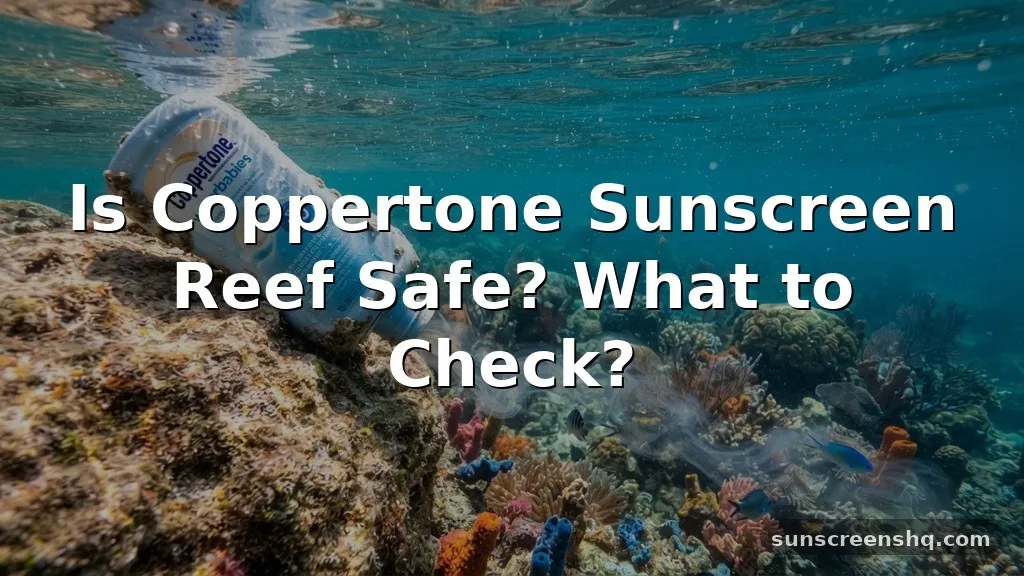
Whether Coppertone sunscreen is reef safe depends on the specific product and its active ingredients, not simply the brand name. Coppertone sells multiple sunscreen formulas, and those products may use different combinations of mineral or chemical UV filters. A careful label check is the only reliable way to assess one bottle.
This matters because sunscreen ingredients can enter coastal water through swimming, rinsing and wastewater, while coral reefs face many other environmental pressures. The practical answer involves checking for oxybenzone and octinoxate, understanding what “reef safe” really means, and choosing suitable sun protection without sacrificing skin safety.
Coppertone sunscreen cannot be called reef safe as one single category because the brand offers different formulas. Some products may avoid ingredients that are commonly restricted in reef-protection laws, while other formulas may contain chemical UV filters that environmentally conscious swimmers prefer to avoid. The product name, SPF number or “sport” label does not answer the question by itself.
Start with the active ingredient panel on the back of the bottle. In the United States, sunscreen labels identify active ingredients separately from inactive ingredients.
Common mineral filters include zinc oxide and titanium dioxide. Common organic, sometimes called chemical, filters include oxybenzone and octinoxate, along with other UV-absorbing compounds.
A product that contains zinc oxide or titanium dioxide may be a mineral sunscreen, but that description still needs context. Particle size, coating, formulation and how the product behaves in water can affect environmental considerations. “Mineral” does not automatically mean harmless to every marine ecosystem, and “chemical” does not describe a product’s overall danger in a simple or complete way.
For a Coppertone product, the most sensible decision process is:
- Read the complete active ingredient list rather than relying on front-label marketing.
- Check whether oxybenzone or octinoxate appears among the active ingredients.
- Look for mineral filters such as zinc oxide or titanium dioxide if you prefer a mineral option.
- Confirm local beach, park or destination rules before swimming.
- Use enough sunscreen to protect your skin and reapply as the label directs.
The phrase “reef safe” has no single worldwide legal definition. A sunscreen may be marketed as reef friendly because it excludes two frequently discussed ingredients, yet that label does not prove the product has no environmental impact. The strongest answer is therefore product-specific: identify the exact Coppertone formula, inspect its ingredients and consider how and where you plan to use it.
Why Sunscreen Ingredients Matter in Marine Water

Sunscreen reaches the marine environment in several ways. Swimmers can wash product from their skin directly into the sea, while showers and laundry can send residues into wastewater systems.
Once released, ingredients may remain in the water or settle near sensitive habitats. Coral reefs are especially important because they support complex communities of fish, invertebrates, algae and microorganisms.
Oxybenzone and octinoxate receive frequent attention in discussions about reef protection. Some jurisdictions have restricted or banned sunscreens containing these ingredients in specific coastal areas.
Hawaii, for example, is associated with restrictions on certain sunscreen chemicals, but rules can differ by location and may change. A local ban is a legal requirement for that destination; it is not a universal scientific label that classifies every other ingredient as safe or unsafe.
Research into sunscreen pollution considers more than a short list of chemicals. Scientists examine concentration, exposure time, water movement, the condition of coral reefs and the effects of complete product formulations. A sunscreen’s environmental behavior may also depend on whether it dissolves, disperses or remains attached to particles in water.
The National Oceanic and Atmospheric Administration offers background on sunscreen and coral reefs through its information about sunscreen and coral health. That context helps explain why a simple “reef-safe” badge should not replace ingredient awareness.
Marine protection also involves behavior. Applying sunscreen before leaving for the beach gives the product time to adhere to the skin and can reduce immediate wash-off.
Rash guards, wide-brimmed hats and shade reduce the amount of sunscreen needed. Avoiding contact with coral, standing on reef structures and following protected-area instructions matter just as much as the product choice.
How to Read a Coppertone Ingredient Label
The back label provides more useful information than broad phrases such as “natural,” “ocean friendly” or “reef safe.” Find the section listing active ingredients and note the names and percentages. Then review the inactive ingredients for fragrance, preservatives, emollients and other components that may affect personal skin tolerance.
Mineral filters
Zinc oxide and titanium dioxide are the main mineral sunscreen filters used in consumer sun protection. They work primarily by absorbing, scattering and reflecting ultraviolet radiation at the skin’s surface. A mineral formula may suit people who want to avoid oxybenzone or octinoxate, although the environmental profile of a complete product still requires careful interpretation.
The label may describe a formula as non-nano. That term generally refers to the size of mineral particles used in the formulation.
It can be relevant to people assessing marine exposure, but “non-nano” alone does not certify a sunscreen as reef safe. It also does not guarantee that the lotion will feel light, disappear fully on darker skin tones or resist removal during swimming.
Chemical filters
Chemical sunscreens use organic UV filters that absorb ultraviolet energy. Oxybenzone and octinoxate are the names most often discussed in reef-related searches, but they are not the only chemical sunscreen ingredients available. A formula can omit those two and still contain other filters that some consumers may wish to research.
Do not assume that a bottle is reef friendly because it says “broad spectrum” or has a high SPF. Broad spectrum describes UVA and UVB protection.
SPF primarily communicates protection against sunburn from UVB under standardized testing conditions. Neither term describes a product’s effect on coral reefs.
| Label detail | What it tells you | What it does not prove |
|---|---|---|
| Zinc oxide or titanium dioxide | The formula uses mineral UV filters | That every ingredient is harmless to marine life |
| Oxybenzone or octinoxate | The product contains ingredients often restricted in certain locations | That the entire product has the same environmental impact in every setting |
| Broad spectrum | The sunscreen is designed to protect against UVA and UVB radiation | That it is reef safe |
| Non-nano | The manufacturer identifies the mineral particles as non-nano | That the product has no marine or skin-related considerations |
| Reef-safe marketing language | The brand is making an environmental positioning claim | A universal legal or scientific certification |
Does Coppertone Make a Reef-Safe Sunscreen?
Coppertone may offer products that align more closely with a consumer’s reef-conscious preferences, but the answer must be tied to the exact product label. Brands reformulate products, sell different versions in different countries and create separate lines for babies, faces, sport use, sensitive skin and daily wear. A general statement about Coppertone can become inaccurate when a shopper is holding a different formula.
Searchers often want a simple yes or no because they are choosing sunscreen for a beach trip. A better answer is conditional: check the active ingredients, avoid products restricted at your destination and select a formula that provides dependable protection for your skin. If your priority is avoiding oxybenzone and octinoxate, confirm that neither appears on the package instead of trusting a retailer description or an old online review.
Some mineral products use zinc oxide, titanium dioxide or both. These products may be called physical, mineral or reef-conscious sunscreen. They can leave a visible cast, feel thicker or require more rubbing than some chemical lotions.
Those trade-offs vary by formula. A mineral sunscreen that you dislike and apply inconsistently may protect less effectively than a different product you can use correctly.
There is also a difference between “reef safe” and “reef-friendly.” These phrases are not interchangeable with formal approval. The best brands make their ingredient lists easy to find and explain their claims carefully, but shoppers should still inspect the packaging because product pages and retailer listings can be incomplete.
Reef-Safe Sunscreen Claims and Their Limits
“Reef safe” sounds definitive, but it has no universally accepted definition across all countries, beaches and scientific institutions. One manufacturer may use the term to mean no oxybenzone or octinoxate.
Another may include a broader list of excluded ingredients. A third may use “reef friendly” as a general marketing phrase without describing a test standard.
That uncertainty does not make environmental concerns irrelevant. It means buyers should separate three questions:
- What is legal? Does the destination prohibit specific sunscreen ingredients?
- What is in the product? Does the label identify mineral filters, chemical filters and other relevant components?
- How will it be used? Will the sunscreen be applied directly before entering the water, or can shade and protective clothing reduce the amount needed?
“Biodegradable sunscreen” also deserves careful attention. Biodegradable may describe how certain ingredients break down under particular conditions, but it does not automatically mean that the product is harmless while it is present in seawater. Consumers should ask what the claim refers to and whether the brand explains its basis.
The same caution applies to words such as pure, simple, natural and clean. A natural ingredient can still affect aquatic organisms, and a synthetic ingredient is not automatically dangerous.
Ingredient transparency is more useful than a vague appeal to nature. The product’s complete formula, exposure route and location all matter.
Choosing Sun Protection Without Sacrificing Skin Safety
Environmental concerns should not lead people to skip sun protection. Ultraviolet exposure can damage skin, cause sunburn and contribute to premature skin aging. The right sunscreen is one you can apply generously, spread evenly and reapply after swimming, sweating or towel drying according to the label.
Choose a broad-spectrum sunscreen with an SPF appropriate for your needs and follow its directions. People with sensitive skin may prefer a fragrance-free mineral formula, but individual reactions vary. A product designed for the face may be less irritating around the eyes, while a water-resistant sport formula may suit vigorous activity better.
Consider these practical questions before buying:
- Will the texture encourage you to apply enough product?
- Does the formula irritate your eyes, trigger a known allergy or worsen a skin condition?
- Do you need water resistance for swimming or heavy sweating?
- Can you combine sunscreen with a rash guard, hat, sunglasses and shade?
- Does the active ingredient list meet the rules of your destination?
Mineral sunscreen can be a strong option for someone seeking zinc oxide or titanium dioxide, but it is not automatically the best choice for every person or every activity. Some people prefer chemical formulas because they spread easily and leave less visible residue.
Personal adherence matters. A sunscreen used properly is more helpful than a theoretically ideal product that sits unopened in a beach bag.
Apply sunscreen to dry skin before exposure when possible. Cover commonly missed areas such as the ears, neck, tops of the feet, hairline and backs of the hands.
Reapply as directed, especially after water contact. These habits protect skin while also reducing the need to add extra product later because of an avoidable sunburn.
How to Prepare for a Reef or Beach Visit
Destination rules should be checked before travel, especially for marine parks, protected reefs and island communities. A product permitted at home may not be permitted at the beach you plan to visit. Regulations can identify specific ingredients, product categories or sales restrictions, so read the current local guidance rather than relying on a general internet list.
Pack sun-protective clothing as part of your plan. A long-sleeved rash guard, hat and shade can reduce direct ultraviolet exposure and the quantity of lotion that enters the water. Clothing does not replace sunscreen on uncovered skin, but it can make protection more consistent during long periods outdoors.
Keep the bottle closed when it is not in use and prevent spills near shorelines. Avoid spraying sunscreen close to the water, where wind can carry droplets beyond the skin.
If you snorkel or dive, maintain distance from coral and never stand, kick or rest equipment on reef structures. Reef damage can result from physical contact as well as water pollution.
A simple pre-trip checklist can prevent last-minute decisions:
- Identify the exact sunscreen product and read its current label.
- Check local rules for oxybenzone, octinoxate and other restricted ingredients.
- Pack protective clothing, a hat and suitable shade equipment.
- Apply sunscreen before reaching the water whenever practical.
- Follow the product’s reapplication and water-resistance instructions.
These steps are useful whether the bottle is from Coppertone, Banana Boat, Sun Bum, Neutrogena, Hawaiian Tropic or another brand. Brand comparisons may help shoppers find a preferred texture or active ingredient, but no brand name removes the need to verify the individual product.
What the Best Answer Means for Coppertone Shoppers
For someone asking, “Is Coppertone sunscreen reef safe?” the most accurate response is not a blanket endorsement or rejection. Coppertone products should be assessed individually. Check the active ingredients, understand the limits of reef-safe claims and follow the rules where you will swim.
If you want to avoid oxybenzone and octinoxate, look for a formula that does not list them. If you prefer mineral protection, seek zinc oxide or titanium dioxide and consider whether the label identifies the product as non-nano. Those choices can narrow your options, but they do not create a universal guarantee about coral reefs.
The term “reef safe” also should not distract from basic sunscreen performance. A formula that provides broad-spectrum protection, suits your skin and encourages correct application remains important. Combine it with shade and sun-protective clothing to reduce exposure and product wash-off.
Keep the decision evidence-based and practical. Read the package you are actually buying, not just a search result, social-media post or outdated product review. Formulas change, and two bottles with similar names can have different active ingredients.
Conclusion
The question of is Coppertone sunscreen reef safe has a product-specific answer. Some formulas may fit a reef-conscious routine, while others may contain ingredients restricted or avoided in certain coastal areas. Check the active ingredient panel for oxybenzone, octinoxate, zinc oxide and titanium dioxide, then confirm the rules at your destination.
Choose reliable sun protection that you will apply correctly, and add shade or protective clothing whenever possible. A careful label check is more trustworthy than a broad brand claim, so inspect the exact Coppertone product before your next swim.
Frequently Asked Questions
Does Coppertone make a reef-safe sunscreen?
Coppertone sells multiple sunscreen formulas, so the answer depends on the exact product. Read its active ingredient panel and check local rules. A formula without oxybenzone or octinoxate may suit some reef-conscious preferences, but “reef safe” has no universal definition or guarantee.
Does Coppertone have oxybenzone?
Some sunscreen formulas may contain oxybenzone, while others may not. Product ingredients can vary by formula and market, so don’t assume every Coppertone bottle is the same. Check the current package for oxybenzone, listed among the active ingredients if present.
Is mineral sunscreen automatically reef safe?
No. Mineral sunscreen commonly uses zinc oxide, titanium dioxide or both, but the complete formulation and environmental context still matter. “Mineral,” “non-nano” and “reef friendly” describe useful product features or claims, not a universal certification that eliminates all marine concerns.
What should I check before using sunscreen near coral reefs?
Read the exact ingredient list, check destination-specific restrictions and consider whether the formula contains oxybenzone or octinoxate. Apply sunscreen before entering the water, use protective clothing and avoid touching coral. These steps support both effective skin protection and more responsible marine recreation.