
The question of whether you tan better with sunscreen has a simple answer: sunscreen may let you spend more time outdoors before burning, but it doesn’t make tanning healthier or guarantee a deeper colour. A tan is still a response to ultraviolet exposure, and that exposure can cause skin damage even when your skin doesn’t turn red. Understanding SPF, UVA and UVB rays, application, and safer alternatives can help you make sensible choices without mistaking a slower tan for protected tanning.
You may tan while wearing sunscreen, but sunscreen does not improve the tanning process. Its purpose is to reduce the amount of ultraviolet radiation reaching your skin, especially the UVB rays that contribute strongly to sunburn. Broad-spectrum sunscreens also help protect against UVA rays, which penetrate the skin more deeply and contribute to tanning, premature skin changes, and other forms of skin damage.
People sometimes feel that sunscreen helps them tan “better” because it can reduce the chance of an early sunburn. Without protection, someone may become red, uncomfortable, and forced to leave the sun quickly.
With sunscreen, that person may stay outside longer and develop a gradual change in skin colour instead. That difference can make the result appear more even, but it does not make the underlying UV exposure harmless.
A tan signals that the skin has responded to ultraviolet radiation. It is not a reliable sign of good health, and a darker glow does not prove that the skin has been protected.
Sunscreen can lower exposure, but it cannot remove every risk associated with sun rays. No sunscreen blocks 100% of UV radiation, and protection becomes less effective when the product wears off, washes away, or is applied too thinly.
The outcome also depends on the sunscreen’s SPF, whether it offers broad-spectrum protection, how much is applied, and how often it is reapplied. Water, sweat, clothing, shade, time of day, and individual skin characteristics all affect how much UV reaches the body. That is why two people can use similar products and see different tanning results.
How Sunscreen Works on UVA and UVB Rays
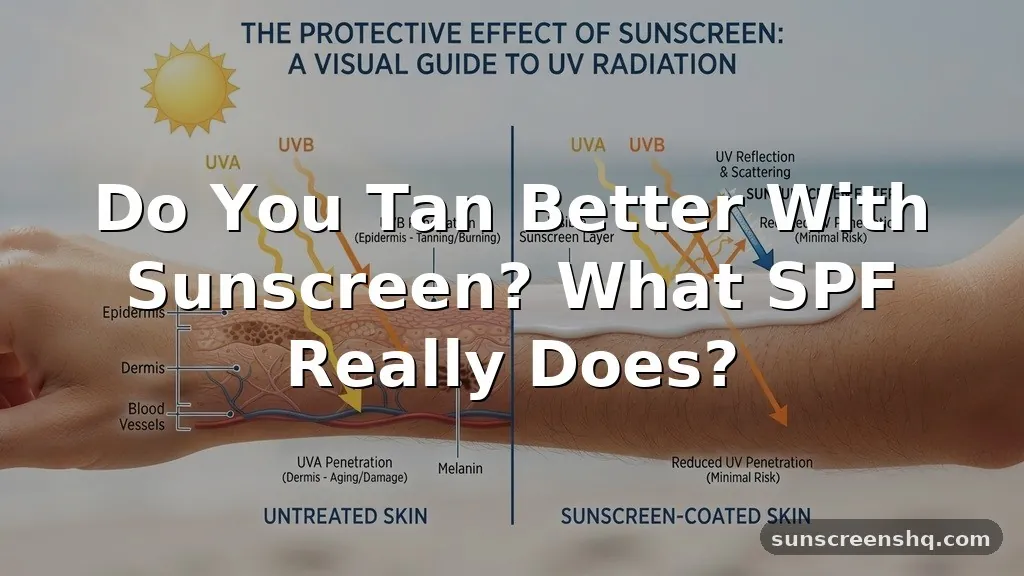
Sunscreen works by using filters that absorb, scatter, or reflect some ultraviolet radiation before it reaches living skin cells. Products generally contain either chemical filters, mineral filters, or a combination of both.
Mineral sunscreens commonly use zinc oxide or titanium dioxide, while other formulas use organic filters that absorb UV energy. The product’s label explains the type of protection it provides.
UVB rays are strongly associated with sunburn, although both UVA and UVB contribute to skin damage. UVA rays can reach deeper layers of the skin and are also involved in tanning and long-term changes caused by sun exposure. Because the two types of rays affect the skin in different ways, SPF alone does not describe every aspect of protection.
SPF primarily communicates how well a sunscreen protects against UVB-related sunburn under testing conditions. A higher SPF generally provides more protection from UVB, but the number should not be treated as permission to stay in direct sunlight indefinitely. SPF 30, SPF 50, and SPF 100 products all require correct application to work as intended.
Broad-spectrum wording matters because it indicates that the sunscreen is designed to protect against both UVA and UVB. A product with broad-spectrum protection may help reduce the total amount of ultraviolet exposure that reaches the skin, but it still cannot prevent every tanning response. The skin may continue to produce more pigment after exposure, particularly during long periods outdoors.
The U.S. Food and Drug Administration’s explanation of how sunscreen helps protect skin provides useful background on sunscreen labels, SPF, and application. Reading the label is important because different products can have different water-resistance claims, textures, and directions for use.
Why sunscreen can appear to improve a tan
Sunscreen can change the experience of sun exposure without making tanning beneficial. Someone who applies sunscreen may avoid the intense redness that develops quickly without protection.
They might then spend more hours outside, creating a slower colour change that seems more controlled. In reality, the skin is still receiving UV radiation, and the visible tan still represents a biological response to that exposure.
Uneven application can also create confusing results. Areas covered generously may remain lighter, while missed patches may tan or burn more quickly.
Rubbing the product away, swimming, sweating, or forgetting to reapply can produce streaks and uneven colour. A consistent approach to sun protection is more important than choosing a tanning-focused product.
What SPF 15, 30, 50, and 100 Mean for Tanning
There is no single SPF that is “best for tanning.” A suitable product depends on the level of exposure, the product’s broad-spectrum coverage, your skin’s response to sunlight, and whether you can apply it correctly and reapply it. People who ask whether they can tan with SPF 50 often assume the higher number prevents tanning completely.
It does not. It reduces more UVB exposure than lower SPF products, but some radiation still reaches the skin.
SPF 15, SPF 30, SPF 50, and SPF 100 should not be viewed as a step-by-step tanning scale. Moving to a lower SPF simply to tan faster increases exposure rather than creating a healthier colour. A higher SPF can be especially useful when sunburn would develop quickly, during prolonged outdoor activity, or when strong sunlight is difficult to avoid.
| Product label | What it indicates | What it does not mean |
|---|---|---|
| SPF 15 | Lower labelled protection against UVB-related sunburn | That tanning is safe or that reapplication is unnecessary |
| SPF 30 | Higher UVB protection than SPF 15 when used correctly | That you can stay outside without limits |
| SPF 50 | Very high labelled protection against UVB-related sunburn | That no tanning or UV exposure can occur |
| SPF 100 | Very high labelled protection, subject to correct use | That the product blocks every sun ray or needs no reapplication |
The SPF number also does not tell you how long you can safely remain in the sun by multiplying it against an individual burn time. Real-world protection changes with application amount, sweating, water, rubbing, cloud cover, reflected light, and the strength of the sun. A person should not use SPF as a countdown clock.
For tanning concerns, the key question is not “Which SPF lets me tan most effectively?” A better question is “How can I reduce unnecessary UV exposure while achieving the appearance I want?” That shift leads many people toward sunscreen, clothing, shade, and a self-tanner rather than deliberately increasing exposure.
How to Use Sunscreen Properly Outdoors
Sunscreen only works well when enough product covers the exposed skin and the protection remains in place. A thin, rushed layer can leave gaps that burn or tan more quickly.
Application should include commonly missed areas such as the ears, neck, tops of the feet, hairline, and backs of the hands. Lips need a suitable product designed for that area.
Apply sunscreen according to the product directions before sun exposure, then reapply as directed, especially after swimming, sweating, towelling off, or extended time outdoors. Water-resistant does not mean waterproof. It describes how long the product may retain its stated protection during water exposure under testing conditions, not whether it remains fully intact all day.
Use sunscreen as one part of sun protection rather than the only barrier between your skin and UV rays. Clothing, a hat, sunglasses, shade, and timing outdoor activities away from the strongest sunlight can all help reduce exposure. These measures matter because people often apply too little sunscreen or forget areas that are difficult to see.
- Choose a broad-spectrum sunscreen with an SPF appropriate for your planned exposure.
- Cover all exposed areas instead of applying only to the face, shoulders, or arms.
- Reapply according to the label and after swimming, sweating, or towelling.
- Use shade and protective clothing during longer periods outside.
- Leave the sun if your skin becomes hot, painful, or visibly red.
- Consider a self-tanner if you want colour without deliberately increasing UV exposure.
Some people search for “how to tan with sunscreen” because they want a gradual result. The safest practical answer is to avoid treating sunscreen as a tanning tool.
Wear it for protection, accept that some tanning may still occur, and use a cosmetic self-tanner if a darker appearance is the main goal. A self-tanner changes the appearance of the skin without providing protection from sun exposure, so sunscreen is still needed outdoors.
Why a Tan Does Not Equal Healthy Skin
A tan can look even, attractive, or associated with time spent outdoors, but appearance does not reveal the full effect of UV exposure. The skin changes its pigment after ultraviolet radiation reaches it. That response may reduce the visibility of redness for some people, yet it does not erase earlier exposure or guarantee protection from future damage.
Sunburn is an obvious warning sign, but skin damage can occur without a dramatic burn. Repeated exposure may affect the skin over time, and a person who rarely burns can still receive substantial UVA and UVB exposure. Skin type changes the way someone responds, but no skin tone makes deliberate unprotected exposure risk-free.
This is why the healthiest way to tan is not to seek a longer or stronger period in the sun. If the goal is a temporary glow, a self-tanner can provide colour without requiring intentional UV exposure. If the goal is outdoor enjoyment, sun protection allows people to spend time outside while reducing, rather than eliminating, exposure.
There is also a difference between a cosmetic result and a health outcome. A deeper tan may seem like evidence that sunscreen “worked” because it developed gradually, but sunscreen’s job is to reduce UV reaching the skin, not to produce pigment. A product marketed as tan sunscreen should still be assessed by its broad-spectrum claims, SPF, directions, and suitability for your skin.
Common Situations That Change the Answer
Can you tan with SPF 50?
Yes, tanning can still occur with SPF 50 because SPF 50 does not block every UV ray. However, the product is intended to reduce UVB exposure and sunburn risk when applied and reapplied correctly. Choosing SPF 50 because it provides stronger labelled protection is not the same as choosing it to tan faster.
Is SPF 50 too high for tanning?
SPF 50 is not too high simply because you want some colour. Lowering protection to accelerate tanning increases UV exposure and does not create a healthier result. If your priority is reducing sunburn and skin damage, use suitable broad-spectrum protection and consider a self-tanner for additional colour.
Can you tan with SPF 30 or SPF 15?
Some people can tan while using SPF 30 or SPF 15, but the number does not determine whether tanning will happen. Skin type, exposure time, UV intensity, application, and reapplication all matter. SPF 15 should not be treated as a safe tanning setting, and no SPF removes the need for other protective measures.
Why did I burn even though I used sunscreen?
Burning can happen if too little sunscreen was applied, areas were missed, the product was not reapplied, or water and sweat removed it. Sunscreen may also have been used as the only form of protection during extended exposure. Move out of direct sun when skin becomes red or painful and follow the product’s directions in future.
People also sometimes compare their results with comments from online discussions, including searches such as “do you tan better with sunscreen Reddit.” Personal experiences can be useful for identifying practical concerns, but they do not establish how sunscreen works for everyone. One person’s tanning speed, skin response, or product routine may not apply to another person.
Does Sunscreen Prevent Tanning Completely?
Sunscreen can reduce tanning, but it does not necessarily prevent it completely. Its filters lower the amount of UV radiation reaching the skin, and broad-spectrum products address both UVA and UVB. Because some radiation can still reach the skin, pigment changes may occur, particularly after prolonged exposure or imperfect application.
The phrase “prevent tanning” can also be misleading because prevention depends on more than the bottle. Staying in shade, covering the body, limiting exposure time, and avoiding deliberate sunbathing reduce opportunities for a tan to develop. Sunscreen supports those choices; it does not replace them.
For someone hoping to tan quickly, there is no reliable, healthy timetable based on SPF. Questions such as how long it takes to tan with SPF 50 or how long to tan without sunscreen cannot be answered safely with one number. UV strength, location, season, skin type, clothing, product use, and time outdoors can all change the result, while intentional exposure always carries the possibility of burning and skin damage.
A gradual-looking tan is not automatically a safe tan. The skin may darken before discomfort appears, and UVA exposure can contribute to tanning without producing the same immediate redness associated with UVB. That makes visible skin colour a poor way to judge whether exposure has been harmless.
Conclusion: Sunscreen Can Reduce Exposure, Not Make Tanning Healthy
The answer to whether you tan better with sunscreen is that you may develop colour while wearing it, and you may avoid the early burn that ends an outdoor session, but sunscreen does not make tanning healthier or guarantee a deeper result. Use broad-spectrum SPF as directed, reapply after water or sweat, add shade and clothing, and avoid using the SPF number as a time limit.
If you want a glow without deliberately increasing UV exposure, a self-tanner is a more suitable cosmetic option. Whatever approach you choose, remember that sunscreen reduces risk; it does not make sun exposure harmless.
Frequently Asked Questions
Do you tan better with sunscreen?
You may tan more gradually with sunscreen because it reduces UV exposure and can help prevent an early sunburn. However, sunscreen does not improve tanning or make it healthy. A tan still indicates a response to ultraviolet radiation, and sunscreen cannot block every UVA or UVB ray.
What SPF is best for tanning?
No SPF is best for deliberately tanning. SPF 30, 50, and higher products reduce UVB exposure when used correctly, but they do not make intentional tanning risk-free. Choose broad-spectrum protection for sun exposure and use a self-tanner if you want additional colour without more UV.
Is SPF 50 too high for tanning?
SPF 50 is not too high for someone who wants strong labelled protection from UVB-related sunburn. It may still allow some tanning, because no sunscreen blocks all ultraviolet radiation. Reducing SPF to tan faster increases exposure rather than creating a safer or healthier result.
What is the healthiest way to tan?
The healthiest approach is to avoid deliberate UV tanning and use a self-tanner for a cosmetic glow. Outdoors, wear broad-spectrum sunscreen, protective clothing, and shade, and limit exposure time. Self-tanner does not protect against sun rays, so sunscreen remains necessary outside.