
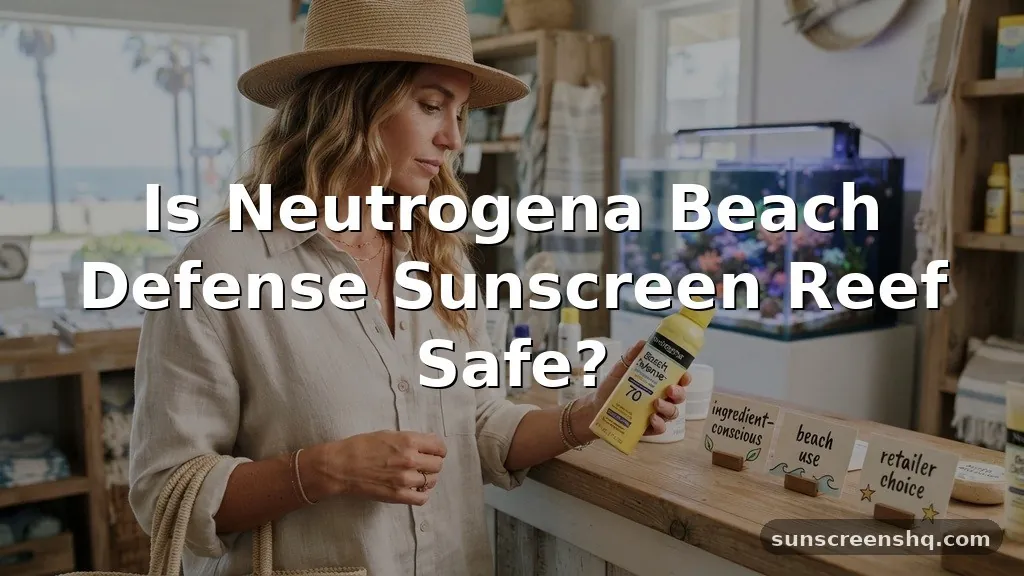
Whether Neutrogena Beach Defense sunscreen is reef safe depends on the exact product, its ingredients, and the environmental rules where you plan to swim. The Beach Defense range includes different formulas, such as sunscreen lotion and sunscreen spray, so one product should not automatically represent every version.
The label matters. This article explains how to assess the formula, what “reef safe” really means, why oxybenzone and octinoxate receive attention, and how to choose sun protection that fits both your skin and the marine environment.
There is no single yes-or-no answer for every Neutrogena Beach Defense product. The most accurate answer is that you should check the active ingredients on the specific bottle before calling it reef safe. Product names can cover several forms, including lotion, spray, mist sunscreen, and different SPF levels. Their formulas may not be identical.
The phrase “reef safe” also lacks one universally accepted legal definition. Some shoppers use it to mean a sunscreen that excludes oxybenzone and octinoxate.
Others use it more broadly for products that avoid ingredients associated with concern about coral reefs and reduce the amount of sunscreen entering coastal water. Those are related ideas, but they are not interchangeable.
Neutrogena Beach Defense is designed for sun protection during outdoor activities, including time at the beach. That purpose does not automatically prove that every formula has no environmental impact. A sunscreen can offer broad spectrum UVA and UVB protection while still requiring a closer look at its chemical filters and local restrictions.
For a reliable assessment, turn the package around and examine the active ingredients panel. Look for the sunscreen filters, the product form, and any current environmental statement from the manufacturer. If the label is unavailable, avoid assuming that “beach,” “ocean,” “natural,” or “reef” language tells you the full story.
- Identify the exact Beach Defense product and SPF.
- Check whether it is a lotion, aerosol, pump spray, or body mist.
- Review the active sunscreen ingredients rather than relying only on front-label wording.
- Check local beach or marine regulations before swimming.
- Apply only the amount needed and allow lotion to absorb before entering the water.
This approach is more dependable than treating every Neutrogena sunscreen as the same. Neutrogena Ultra Sheer, Clear Face, and Beach Defense products may serve different skin types and uses, but their environmental profiles should be evaluated separately.
What makes a sunscreen reef safe?
A reef-safe sunscreen generally refers to a product that avoids certain chemical UV filters associated with concern about coral reefs, especially oxybenzone and octinoxate. However, “reef safe” is not a universal certification that guarantees zero effect on marine life. The term can appear in marketing without explaining the complete ingredient profile or how the product behaves in water.
Coral reefs are sensitive marine ecosystems. Sunscreen can enter seawater when swimmers rinse it from their skin, wash it off in showers near the coast, or release it through spray drift and accidental overspray.
The environmental question is therefore not limited to whether one ingredient appears on the label. It also involves how much product reaches the water, where it is used, and what other chemicals the formula contains.
Oxybenzone and octinoxate are often discussed because some destinations have created restrictions involving those filters. A product described as oxybenzone-free may still contain other chemical filters, and that does not automatically establish that it is reef safe under every interpretation. Conversely, a mineral sunscreen that uses zinc oxide may still require attention to particle size, coating, and the full formula.
The term “non-nano zinc” also needs context. Zinc oxide is a mineral UV filter, but not every zinc formula has the same texture, dispersion, or application method.
A mineral product can reduce reliance on certain chemical filters, yet aerosol application may create more overspray than a lotion. The formula and how people use it both matter.
For broader marine context, readers can consult the National Oceanic and Atmospheric Administration’s explanation of coral reef threats. It is useful to separate established environmental information from simplified “reef safe” claims printed on sunscreen packaging.
Why the phrase can be confusing

“Reef safe” may describe an ingredient choice, a brand position, a retailer category, or a consumer preference. It does not necessarily identify a formal testing standard. A sunscreen can be marketed as safe for beach use while making no claim that it has been proven harmless to coral reefs.
That uncertainty does not make the term meaningless. It means shoppers should ask a more precise question: Does this particular formula avoid the filters I want to avoid, comply with the destination’s rules, and provide adequate sun protection for my skin? That question produces a more useful answer than the label alone.
How to read the ingredients in Beach Defense
The ingredient panel is the best starting point for evaluating a Beach Defense formula. Sunscreen products list active ingredients that filter, absorb, or scatter ultraviolet radiation.
The rest of the ingredients support texture, stability, fragrance, water resistance, preservation, and application. A spray, lotion, and dry-touch formula may feel very different because their inactive ingredients and delivery systems differ.
First, identify the UV filters. Chemical filters absorb ultraviolet energy, while mineral filters such as zinc oxide sit on the skin and help absorb, reflect, or scatter UV radiation. The presence of chemical filters does not automatically mean a product is unsafe for people, and the absence of oxybenzone does not automatically establish a complete reef-safe profile.
Next, look specifically for oxybenzone and octinoxate if avoiding those ingredients is your priority. Product labels can change, and regional versions may differ. Do not rely on an old online ingredient list, a product review, or a retailer description if the bottle in your hand says something else.
| Label detail | What it tells you | What it does not prove |
|---|---|---|
| Broad spectrum | The product is intended to protect against both UVA and UVB radiation. | It does not establish that the formula is reef safe. |
| SPF number | It indicates the product’s tested sun-protection rating against sunburn under specified conditions. | It does not describe marine impact or guarantee protection from every type of UV exposure. |
| Oxybenzone-free | The listed formula does not include oxybenzone as an active sunscreen ingredient. | It does not mean the product contains no other chemical filters. |
| Zinc oxide | The formula uses a mineral sunscreen filter. | It does not by itself prove a zero-impact environmental profile. |
| Water resistant | The product is tested to retain protection for a stated period during water exposure. | It does not mean no sunscreen enters water or that reapplication is unnecessary. |
Pay attention to the wording on the front and back. “Sheer,” “dry-touch,” “body mist,” and “ultra sheer” usually describe feel or appearance, not environmental performance. Likewise, “beach defense” communicates intended use, not a formal reef-safe certification.
Why formula differences matter
A lotion spreads directly across the skin, while a sunscreen spray or mist sunscreen disperses through the air before landing on the body. Sprays can be convenient for large areas, but wind can carry product away from the intended application area. This makes careful application especially important near sand, shorelines, and water.
Do not spray sunscreen directly toward your face, and avoid applying it in a way that creates visible drift. Spraying into your hands before applying to the face can reduce accidental inhalation and improve control. These habits help limit waste regardless of whether the formula uses chemical filters, zinc oxide, or both.
Beach Defense, broad spectrum protection, and skin safety
Environmental considerations should not replace effective sun protection. A reef-conscious choice is still a poor choice if it leaves skin inadequately protected. Sun exposure can damage skin even when the weather feels mild, especially around water and sand, where reflected light can increase exposure.
Look for a sunscreen that provides broad spectrum protection. Broad spectrum means the product is intended to protect against UVA and UVB radiation.
UVB contributes strongly to sunburn, while UVA penetrates more deeply and contributes to long-term skin damage and premature skin aging. The SPF number helps describe protection against sunburn, but it does not remove the need for correct application.
Use enough sunscreen to cover exposed skin evenly. Many people apply too little, miss the ears and neck, or forget the backs of the hands and tops of the feet.
Reapply according to the product directions, particularly after swimming, sweating, toweling off, or extended outdoor activity. Water resistance does not mean the product remains fully intact all day.
Beach Defense may appeal to people who want an outdoor sunscreen lotion or sunscreen spray for the body. A dry-touch sunscreen can feel less greasy, while a sheer body formula may be more comfortable for everyday wear. Comfort matters because people are more likely to use a sunscreen consistently when they like its texture and finish.
Choosing between lotion, spray, and mineral sunscreen
Lotion generally gives users more control over where the sunscreen goes. It can be a practical choice for children, people with sensitive areas, and anyone applying product close to the shoreline. A spray may save time on large areas, but it requires attention to wind, inhalation, and missed patches.
Mineral sunscreen containing zinc oxide may suit shoppers who prefer mineral filters or want to avoid specific chemical ingredients. It can leave a visible cast or feel thicker, although newer formulas may improve the finish. A chemical sunscreen may spread more transparently and feel lighter, but the environmental decision depends on the exact filters and the user’s priorities.
Skin compatibility matters too. Fragrance, alcohol, preservatives, and other inactive ingredients can affect how a product feels on dry, sensitive, or irritation-prone skin. Someone with facial breakouts may prefer a product labelled for the face, such as a Clear Face formula, rather than assuming a body sunscreen will behave the same way.
Can you use Neutrogena Beach Defense in Hawaii?
You may be able to use a Beach Defense product in Hawaii, but the answer depends on the current local rules and the exact ingredients. Hawaii has placed restrictions on certain sunscreen chemicals in some contexts, and regulations can change. Check the latest official requirements for the island and location you plan to visit rather than relying on an old travel post or a product’s marketing language.
Rules are only one part of the decision. A sunscreen that meets a local restriction may still not match your personal definition of reef safe.
For example, a shopper may want to avoid oxybenzone and octinoxate, prefer non-nano zinc, or choose a lotion instead of a spray to reduce overspray. Those preferences go beyond simple legal compliance.
Pack the product in its original container so you can verify the active ingredients. If you are buying sunscreen after arrival, read the current label carefully. Travel-size packaging, regional formulas, and updated product versions can make online descriptions unreliable.
Practical beach habits that reduce environmental release
Application technique affects how much sunscreen reaches the marine environment. Apply lotion before arriving at the water when possible, and allow it to settle on the skin. Avoid spraying into the wind or directly over sand, where product can be blown or washed into the sea.
Physical protection can reduce the amount of sunscreen needed. Rash guards, long-sleeved clothing, a wide-brimmed hat, sunglasses, shade, and timing outdoor activities outside the strongest sunlight all support sun protection. These steps do not replace sunscreen on uncovered skin, but they can reduce repeated applications over large areas.
- Apply sunscreen on dry skin before entering the water.
- Use a lotion when wind makes spray application difficult.
- Apply spray outdoors in a controlled area, not toward the face or other people.
- Cover exposed skin with clothing and seek shade when practical.
- Follow posted beach guidance and local sunscreen restrictions.
Responsible use helps regardless of the final label decision. The goal is not to create false certainty. It is to protect skin while reducing avoidable product loss near coral reefs and other marine habitats.
Is Beach Defense safe for children and sensitive skin?
“Safe” can mean several different things in a sunscreen question. It may refer to protection from UV radiation, irritation risk, allergic reactions, environmental concerns, or compliance with local rules. Neutrogena Beach Defense should not automatically be considered suitable for every child or every sensitive skin type simply because it is sold for beach use.
Read the age guidance and directions on the specific package. Infants and very young children require special care, including protective clothing and shade, and parents should follow advice from an appropriate healthcare professional or the product label. Keep sunscreen away from the eyes, and stop using it if a rash or significant irritation develops.
For sensitive skin, test a small area before applying a new product broadly. Fragrance and certain inactive ingredients can bother some users. A mineral sunscreen with zinc oxide may be preferred by people who want to avoid particular chemical filters, but the best option still depends on individual tolerance, texture preferences, and the area being covered.
Children often need help applying enough sunscreen to the ears, hairline, neck, shoulders, and tops of the feet. Sprays can make coverage look complete when patches were missed, so an adult should rub the product in when the label permits and check the entire exposed area. A lotion can make that inspection easier.
What “water resistant” means
Water-resistant sunscreen is tested under specified conditions, but the claim does not mean the product remains unchanged after swimming. Toweling, friction, sweat, and repeated water exposure remove sunscreen. Reapply as directed, even if the product still feels present on the skin.
This point matters for children because active play often includes swimming, sand, towels, and perspiration. The same principle applies to adults using Beach Defense during boating, hiking, sports, or long days outdoors. Protection depends on coverage and reapplication, not only on the SPF printed on the front.
How Beach Defense compares with related sunscreen choices
Searches for Neutrogena Beach Defense often lead to questions about Ultra Sheer, Clear Face, and other Neutrogena sunscreens. These products may target different experiences.
Ultra Sheer commonly signals a lighter-feeling or less visible finish, while Clear Face is associated with facial use. Those names do not tell you whether a product meets your reef-safe preferences.
Compare products by intended body area, SPF, broad spectrum status, water resistance, active filters, and texture. A face sunscreen may avoid the heavy feel that some people dislike, but it may not be the most practical choice for covering the entire body. A body mist can be convenient, yet a lotion may offer more controlled application near water.
The following framework can help you compare without treating product names as environmental guarantees:
| Priority | What to compare | Useful question |
|---|---|---|
| Sun protection | Broad spectrum coverage and SPF | Does it meet the protection level appropriate for the planned activity? |
| Environmental preference | Active UV filters and destination rules | Does it avoid ingredients I choose not to use near marine environments? |
| Application | Lotion, spray, or mist format | Can I apply it evenly without excessive drift or wasted product? |
| Skin comfort | Finish, fragrance, and inactive ingredients | Will I use it consistently without irritation or an unpleasant feel? |
| Body area | Face, body, children, or sensitive areas | Is the formula intended for the skin area and user who will apply it? |
There is no universal winner between chemical and mineral sunscreen. Some people value a transparent, lightweight finish and prefer chemical filters.
Others prioritize zinc oxide or avoiding particular ingredients. The sensible choice balances dependable sun protection, personal skin needs, application habits, and the environmental rules of the place you are visiting.
What to do if the label is unclear
Do not guess from a product photo or assume that every bottle with the same brand name uses the same formula. Check the current packaging, especially the active ingredient panel. If the product was purchased in another country or has been reformulated, regional information may differ.
You can also contact the manufacturer with the exact product name and package details. That approach is more useful than asking whether the entire Neutrogena range is reef safe, because a company may provide information for a particular formula rather than for every product sold under the brand.
Conclusion: making a responsible Beach Defense choice
The question “is Neutrogena Beach Defense sunscreen reef safe?” cannot be answered responsibly from the brand name alone. Check the exact formula, review its active ingredients, distinguish oxybenzone-free claims from broader environmental claims, and confirm the rules at your destination. Broad spectrum sun protection remains essential, so choose a product you can apply evenly and reapply correctly.
If marine impact is a priority, combine careful label reading with shade, protective clothing, controlled application, and local guidance. That gives you a practical way to protect your skin without treating “reef safe” as a guarantee that every formula or use has zero environmental effect.
Frequently asked questions
Is Neutrogena Beach Defense safe for coral reefs?
It depends on the specific Beach Defense formula and your definition of reef safe. Check the active ingredients, especially if you avoid oxybenzone or octinoxate, and review local rules. The product name alone does not establish that every version is harmless to coral reefs or other marine ecosystems.
Is Neutrogena Beach Defense SPF 70 reef safe?
The SPF level does not determine reef safety. SPF describes sunburn protection, not environmental impact. Examine the SPF 70 product’s current active ingredient panel, identify its UV filters, and compare them with your personal preferences and the regulations at the beach or destination where you plan to use it.
Can I use Neutrogena Beach Defense in Hawaii?
You should check current Hawaii requirements and the exact product ingredients before traveling or swimming. Local restrictions may apply to particular sunscreen chemicals, and rules can change. A product that meets local requirements may still not satisfy every shopper’s broader preference for a reef-safe sunscreen.
Is Neutrogena Beach Defense sunscreen safe for children?
Follow the age guidance and directions on the specific package. Children need careful, even application, protection from direct sun, and frequent reapplication after swimming or sweating. Parents should consider the child’s skin sensitivity, avoid contact with the eyes, and seek professional advice for very young infants or persistent irritation.